
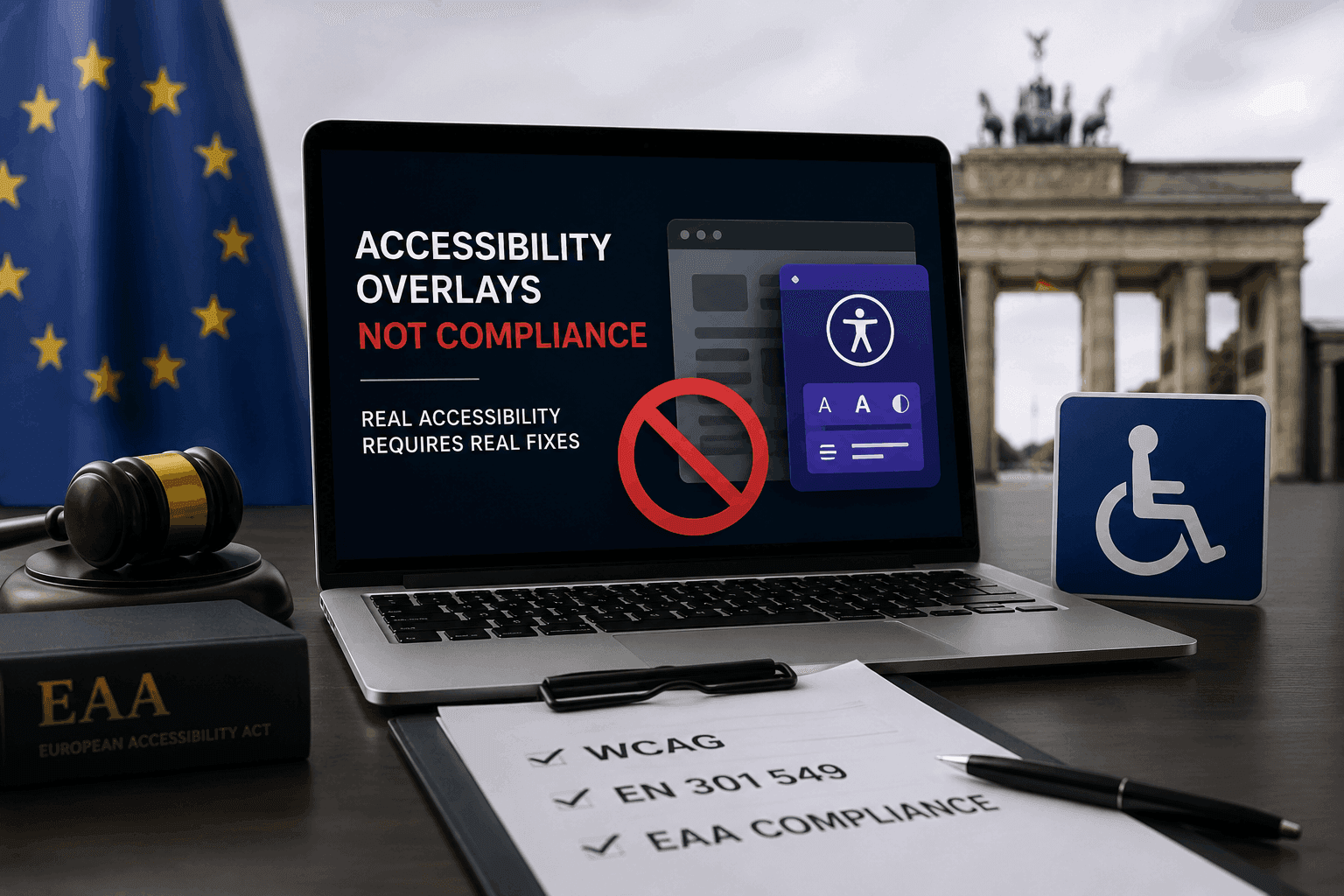
Germany Sends a Clear Message: Accessibility Overlays Are Not Compliance
For years, accessibility overlay vendors have sold a comforting promise to businesses:
“Install one line of code and your website becomes accessible.”
That promise was always too good to be true.
Now, Germany is making that reality impossible to ignore.
Recent guidance connected to Germany’s BIK testing framework has made it clear that websites using accessibility overlays cannot reliably demonstrate conformance with accessibility standards such as EN 301 549 and WCAG.
For companies preparing for the European Accessibility Act (EAA), this is a major wake-up call.
And honestly, it confirms what accessibility professionals, including us at GetWCAG, have been saying for years:
Accessibility widgets are not a replacement for real accessibility work.
What Is BIK?
BIK stands for Barrierefrei Informieren und Kommunizieren, which translates to Accessible Information and Communication.
It is one of Germany’s most recognized accessibility initiatives and testing frameworks, focused on evaluating digital accessibility for websites and applications. BIK is closely connected to WCAG and EN 301 549 evaluation methods and is widely respected within the accessibility industry.
When BIK testing centers publish guidance around accessibility compliance, organizations across Europe pay attention.
That is exactly what is happening now.
What Germany Actually Said
The discussion gained momentum after new guidance from Germany’s BIK testing centers highlighted a serious issue with accessibility overlays.
According to the published statement from BIK:
“For websites that use an overlay tool, the BIK testing centers cannot currently make a reliable statement regarding conformity according to EN/WCAG.”
That sentence may sound technical, but the meaning is significant.
When BIK says they cannot reliably verify compliance on websites using overlays, it sends a strong signal to organizations relying on these tools for EAA readiness.
The core issue is simple:
Overlays sit on top of accessibility problems instead of fixing the underlying code.
And that distinction matters.
The European Accessibility Act Requires Real Accessibility
The European Accessibility Act is not asking companies to appear accessible.
It requires websites, apps, and digital services to actually function for people with disabilities.
That means accessibility must exist in the product itself:
- In the code
- In the structure
- In the design
- In the user experience
Not in a floating toolbar layered on top of an inaccessible website.
To meet WCAG and EN 301 549 requirements, organizations need to address:
- Semantic HTML
- Keyboard navigation
- Screen reader support
- Proper labels and form handling
- Focus management
- Accessible interactive components
- Color contrast
- Error messaging
- Logical heading structure
An overlay cannot rebuild inaccessible architecture.
It cannot correct broken frontend foundations.
And it cannot guarantee legal compliance.
Why Accessibility Overlays Continue to Fall Short
Most accessibility overlays promise quick fixes through JavaScript-based widgets that add features like:
- Font resizing
- Contrast controls
- Reading masks
- Text spacing adjustments
- Automated accessibility “fixes”
While some of these controls may help certain users, they do not solve the core accessibility barriers that prevent disabled users from navigating a website properly.
For example:
- A screen reader user needs correct semantics and landmarks
- A keyboard-only user needs proper focus handling
- A blind user needs meaningful labels and navigation structure
- A user with cognitive disabilities needs clarity and consistency
Those issues must be solved directly in the website itself.
No widget can replace accessible engineering.
And when overlays attempt automated fixes, they often create additional conflicts with assistive technologies instead of improving usability.
That’s one of the reasons why accessibility professionals and disabled users have criticized overlay-based approaches for years.
The Industry Is Finally Facing Reality
For a long time, overlays became popular because they offered businesses something incredibly appealing:
A shortcut.
But accessibility has never been a shortcut problem.
Real accessibility requires:
- Proper development practices
- Accessible design systems
- Manual testing
- Ongoing audits
- Screen reader validation
- Accessibility-aware content publishing
- Long-term maintenance
Germany’s position reflects a growing understanding across Europe that accessibility cannot be treated as a cosmetic layer.
Compliance is increasingly being evaluated based on actual usability, not the presence of a widget.
That changes the conversation entirely.
What Businesses Should Focus On Instead
Organizations preparing for the EAA should move beyond “overlay-first” strategies and focus on sustainable accessibility work.
That includes:
Conducting Real Accessibility Audits
Automated scans are helpful, but they are not enough. Manual testing is essential.
Fixing Accessibility at the Source
Accessibility problems should be resolved in the codebase itself.
Building Accessibility Into Development Workflows
Accessibility should be part of design, QA, development, and content publishing processes from day one.
Continuously Monitoring Accessibility
Websites evolve constantly. Accessibility requires ongoing attention.
Our Position at GetWCAG
At GetWCAG, we’ve always been clear about this:
Accessibility widgets are not a replacement for real accessibility fixes.
Can some interface tools offer additional personalization options? Yes.
But they are not compliance solutions.
They do not replace:
- WCAG remediation
- Semantic frontend development
- Accessible UX design
- Manual accessibility testing
- Proper engineering practices
Accessibility is not something you install.
It’s something you build.
Germany’s latest position through BIK reinforces what the accessibility community has been saying for years:
Real compliance requires real accessibility work.
Final Thoughts
The European Accessibility Act is pushing organizations toward a more mature understanding of digital accessibility.
And Germany’s stance on overlays is an important milestone in that shift.
Businesses now face an important decision:
- Continue relying on shortcuts
- Or invest in genuine accessibility improvements
Only one of those approaches leads to long-term compliance, better user experiences, and true inclusion.
Because accessibility was never supposed to be a floating button.
It was always supposed to be part of the product itself.